What is the difference between risk of ruin and Kelly for prop firm sizing?
Kelly and risk of ruin answer different questions. Kelly looks for a fraction that maximizes long-run growth, given a win rate and a payoff. Risk of ruin asks whether this size is likely to hit a loss level that ends the account. On a prop firm account, that loss level is a firm rule. RangeSight is a risk simulator for education. It is not financial advice.
Last updated: November 10, 2026
What Kelly is optimizing
Kelly sizing looks for the fraction of a bankroll that maximizes long-run growth, given a win rate and a payoff ratio. Full Kelly is aggressive. Many traders talk about a smaller slice because the path is calmer.
Kelly does not see a firm's max-loss rule. It treats the account as a bankroll that can shrink and recover. A prop firm trailing drawdown or hard daily loss is a hard cap.
If a stated edge is strong, Kelly will often want more size than a tight evaluation account can hold. That is a mismatch between the math's objective and the rulebook. Treat neither number as advice.
What risk of ruin is asking
Risk of ruin asks a simpler question. At this size, how likely is this plan to hit a loss level that ends the account before it can recover?
On a prop firm account, that loss level is written in the rules: max loss, trailing drawdown, or daily loss. Convert that dollar or percent limit into a count of full losers at your risk per trade. That count is your cushion. See What is a drawdown cushion, and how do I think about one on a $50k prop account?.
Example only (use your firm's numbers). A $50,000 account with a $2,000 max loss and $400 risk per trade has five full losers of room from the starting balance. Kelly never told you that. Risk of ruin starts there.
The same example at $250 risk per trade has eight losers of room. At $500 it has four. A Kelly fraction does not change those walls. Your size does.
A simple order of operations for a prop firm plan
- Write down the firm's max loss in dollars from the current rules page, and confirm it with the firm.
- Pick a risk per trade you can actually stick to.
- Divide max loss by risk per trade. That is your cushion in losers.
- Only then ask whether a growth fraction would keep you inside that cushion on the win rate and payoff you actually trade.
Trailing drawdowns need one extra step. If the firm trails from a high-water mark, your cushion shrinks after a win. Recheck losers of room from the current trailing level, not only from the starting balance.
Fixed fractional (risk a fixed percent of equity each trade) is a way to apply a size you already chose. It is not a substitute for checking ruin against the firm's wall. You can be fixed fractional at 1% and still be too large for a tight trailing drawdown.
See the two surfaces
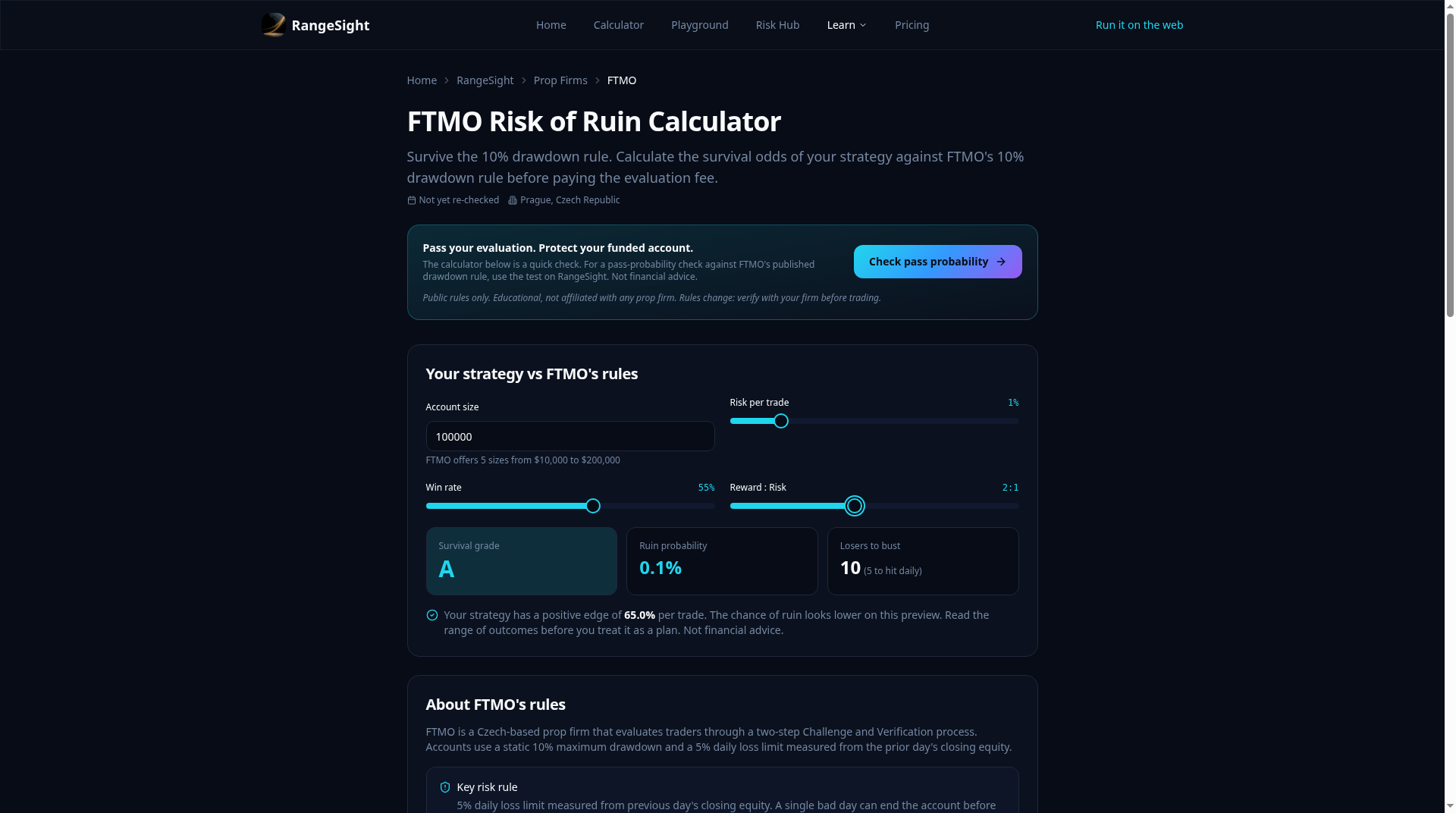
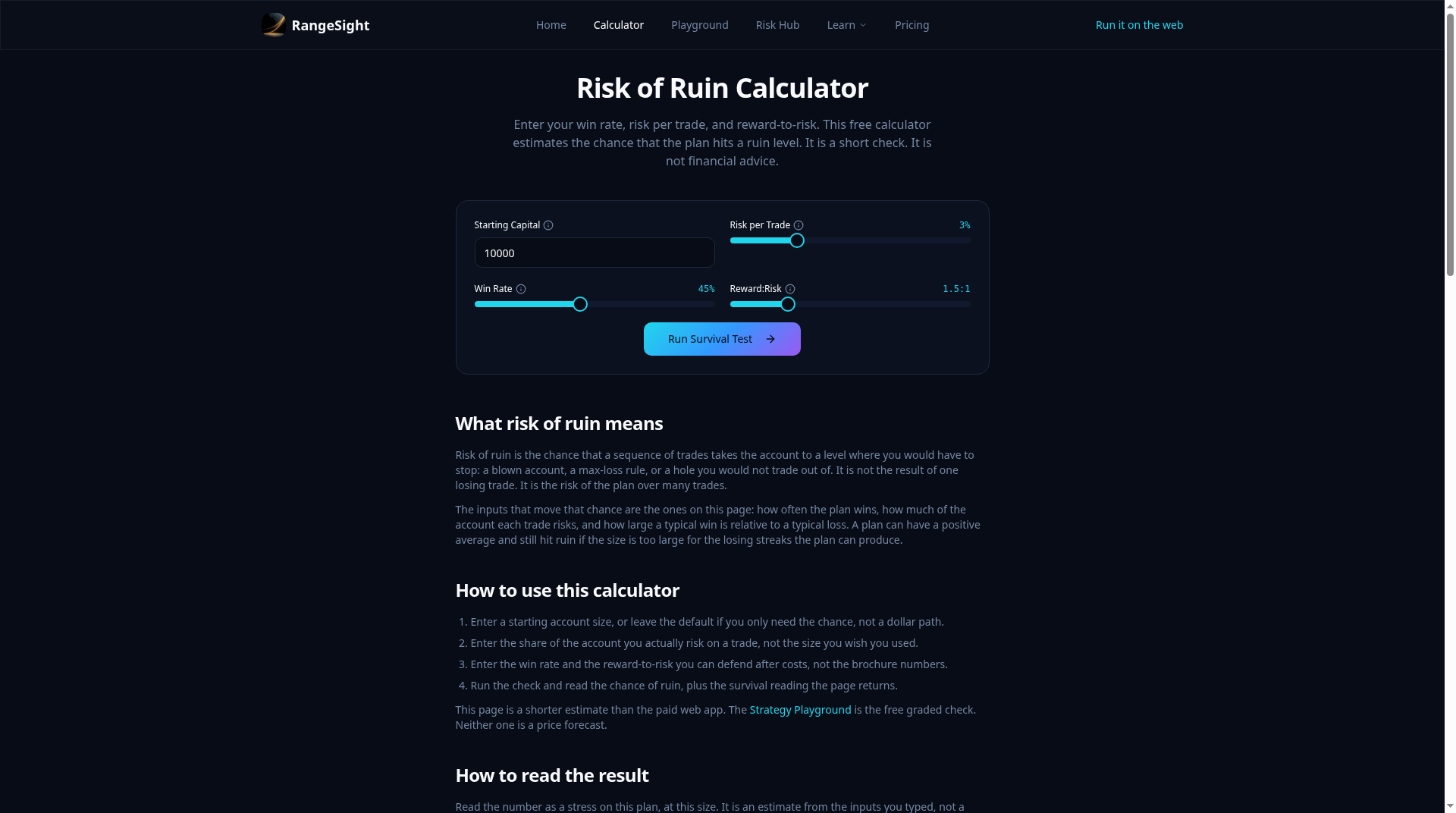
The firm page and the free calculator can show the same demo inputs in two places. Do not quote the on-screen percents or grades as claims, and do not treat a difference between the two pages as a published finding.
FAQ
Does a higher win rate fix a thin cushion?
It helps the probability math, but it does not remove streaks. A higher win rate still prints losing runs. Size for the streak you cannot afford.
Should I use full Kelly on a prop firm eval?
This page does not recommend a size. Full Kelly assumes you can survive deep equity swings. A hard max loss means you often cannot. Start from the cushion, then see whether a growth fraction still fits inside it.
What if my firm uses a trailing drawdown?
Treat the trail as the wall. Recalculate losers of room from the current trailing level after winners lock in. A size that looked fine at the open can become tight after a green morning if the trail moved up.
Is fixed fractional safer than Kelly?
Only if the fraction you picked leaves enough losers of room. Fixed fractional describes how you scale. It does not prove the account survives.
Is this financial advice?
No. Educational only. Not affiliated with any prop firm. Your firm's rules and your own risk tolerance decide the size.
Related
Key Takeaway
Kelly aims at long-run growth. Risk of ruin asks whether this size survives a prop firm's max-loss wall. Use both ideas, then enter your own plan. Not financial advice. RangeSight uses Monte Carlo simulation to show the chance of ruin, the chance of a drawdown, and the range of outcomes. It is not financial advice.
This explains the concept.
But outcomes vary in practice. The same strategy can produce a 40% gain or a 30% drawdown depending on trade sequencing and market conditions.
Test your strategy to see how consistent it actually is → Run survival test
Related articles
Position Sizing for Day Traders: The Math That Keeps You Alive
Position sizing is not about maximizing profit. It's about surviving long enough for your edge to play out.
The 2% Rule vs. Actual Ruin Probability
Everyone knows the 2% rule. Few know whether it actually works for their specific strategy. Here's how to find out.