What is a drawdown cushion, and how do I think about one on a $50k prop account?
A drawdown cushion is the number of full losing trades, at your size, that would take a prop firm account to its max-loss limit. On a $50k account, start from the firm's published dollar or percent limit, divide it by the amount you actually risk per trade, and treat that count as your room. Then check whether a streak that long is ordinary for your plan. This is an educational check, not financial advice.
Last updated: November 10, 2026
Count the cushion in losing trades, not only in dollars
Take the firm's max-loss limit and divide it by your risk per trade. The answer is the number of full losers in a row, from where you start, that ends the account. If you need the definition of drawdown first, see What is drawdown in trading?.
Use a made-up example, not a firm's actual rule: a $50,000 account with a $2,000 max-loss limit. Your firm's numbers will differ, so plug in the limit from its rules page.
| Risk per trade | Losers in a row that end the account |
|---|---|
| $500 | 4 |
| $400 | 5 |
| $250 | 8 |
| $200 | 10 |
"$2,000 of room" can sound large. "Four bad trades" does not. That count is the cushion this page is about.
Check how often that streak can show up
A losing streak is a normal part of any plan that loses some of the time. The question is whether the streak that would end the account is rare over the number of trades you expect to take, or whether it is common.
Do not plan around a single average day. If you drop the size, you need a longer streak to hit the same wall. The strategy can stay the same. The size decides whether an ordinary streak ends the account.
Real trades can cluster more than a simple independent model implies, so treat a friendly streak calculation as the milder case.
Why a trailing drawdown makes the cushion smaller than it looks
On a static limit, profits can add to your cushion. On a trailing limit, the floor follows your peak, so a good run does not buy you as much room as you think. A streak that starts right after a new high is measured from that high, not from where you started.
Firms differ on whether the trail follows intraday or end-of-day balance, and on when it stops trailing. Check the exact wording with the firm. On a trailing account, plan your size as if your cushion is closer to the starting number than to whatever your balance shows after a good day. See What is the difference between trailing and static drawdown in a prop firm?.
What a daily loss limit does and does not fix
A daily loss limit caps how much one bad day can take. That helps only if it actually stops you. If your daily limit is $1,000 and you risk $500 a trade, two losers can end the day. The streak can continue tomorrow from a lower balance. A daily limit can slow a streak down. It does not make it shorter.
A $50k view on a firm page
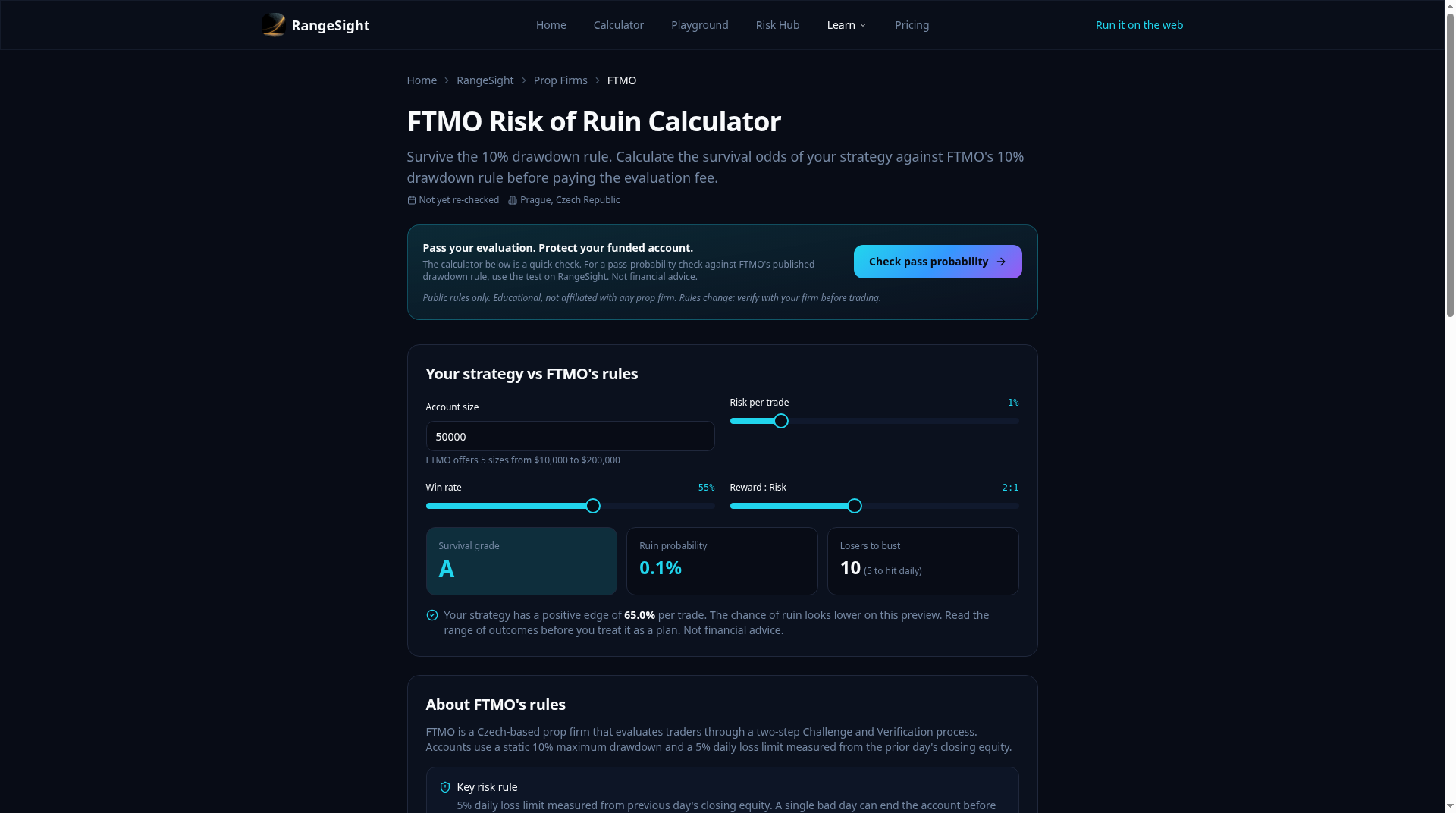
The screenshot below is a demo on the FTMO page, with the account size set to 50000, 55% win rate, 1% risk per trade, and 2:1 reward to risk. It is a demo, not a recommendation. The FTMO page on this site describes a static 10% maximum drawdown and a 5% daily loss limit measured from the prior day's closing equity. That page also showed a "Not yet re-checked" badge in this capture. Confirm the current rule with FTMO. Do not read the grade or ruin figures in the screenshot as a claim or as a comparison with other account sizes.
You can also scan max-drawdown limits across firms on the compare table.

FAQ
How do I calculate my drawdown cushion?
Divide the max-loss limit by your risk per trade. In the made-up example, a $2,000 limit at $250 a trade is a cushion of eight full losers in a row from the starting balance.
What risk per trade is safe for a $50k prop firm account?
There is no universally safe number. It depends on your firm's loss limit, whether it trails, your real win rate, and how many trades you will take. Size so the losing streak that would end you is one you are actually willing to live with, then run your own numbers in a simulator.
Does a higher win rate mean I can risk more?
It can help the probability math, but it does not remove streaks. Reward to risk and the loss limit matter just as much.
Is a trailing drawdown worse than a static one?
For the same headline limit, a trailing floor can leave less room after a winning run, because the floor rises with your peak. Check your firm's exact rule for when the trail stops.
Related
Key Takeaway
A drawdown cushion is how many full losers in a row your max-loss limit can take at your size. Walk through a $50k example, then use your firm's own rule. RangeSight uses Monte Carlo simulation to show the chance of ruin, the chance of a drawdown, and the range of outcomes. It is not financial advice.
This explains the concept.
But outcomes vary in practice. The same strategy can produce a 40% gain or a 30% drawdown depending on trade sequencing and market conditions.
Test your strategy to see how consistent it actually is → Run survival test
Related articles
Do Most Day Traders Lose Money? A 3-Number Check Before You Fund the Next $2,000
Most persistent day traders in the largest public study lost money. Check risk per trade, losing-streak room, and what it takes to climb back before you add funds.
How Many Losses in a Row Can a 60% Win Rate Have?
A 60% win rate still hits four losses in a row more than half the time over 50 trades. Count how many losers you can afford, then size the next eval from that number.
What Risk of Ruin Means for a Trading Plan
What risk of ruin means for a trading plan, and how to read the free calculator.